





Flat roof condensation problems are more common than many homeowners think. According to building surveys, nearly 1 in 3 flat roofs shows signs of moisture damage caused by hidden condensation, not by leaks from outside. That means what looks like a roof problem can be an issue happening inside the structure.
The good news? Spotting the signs early makes all the difference. With the right fixes — from better ventilation to insulation upgrades — you can stop condensation before it spreads. Acting quickly not only protects your home, but also saves money, especially since insurance rarely covers damage caused by poor maintenance.
So, in this guide, you’ll learn the warning signs of condensation in flat roofs, the main causes and how to prevent them, practical solutions — from small fixes to full insulation upgrades — and real repair costs, including emergency tarp installation.
Don’t wait until hidden condensation turns into mold, structural damage and expensive repairs. The time to protect your home is now.
Understanding Flat Roof Condensation Problems
Condensation in a flat roof isn’t always obvious. Many homeowners mistake it for a roof leak, but the truth is often sneakier. Instead of water coming from outside, it builds up inside the roof when warm, moist air meets a cold surface. The result? Droplets form, insulation gets soaked, and the structure weakens over time.
What is flat roof condensation?
Flat roof condensation is trapped moisture that forms within or under the roof structure. It happens when there’s poor ventilation or weak vapor control layers. Over time, this hidden moisture can cause:
- Mold growth and musty odors.
- Damp insulation that loses effectiveness.
- Rotting timber and structural damage.
Why does condensation happen in flat roofs?
Flat roofs are more prone to condensation than pitched roofs because:
- Less ventilation: Flat designs don’t allow air to flow as freely.
- Cold deck construction: Many older flat roofs have insulation below the deck, leaving surfaces cold.
- Poor vapor barriers: Missing or weak vapor control layers let warm indoor air seep into the roof space.
- Rapid temperature swings: In some climates, the roof deck goes from hot sun to cold night in hours, stressing the materials.
Bottom line: Flat roof condensation problems are silent at first. However, they can become expensive fast. By understanding what condensation is and why it happens, you’re already one step closer to spotting it early and stopping the damage before it spreads.
Also read:
- Roof Repairs You’ll Likely Face as a Homeowner
- Fibreglass Flat Roof Problems Every Homeowner Should Know
Signs of Condensation Problems in Flat Roofs
Condensation in a flat roof doesn’t announce itself with a siren. It shows up quietly and if you’re not paying attention, the damage piles up. Knowing the signs early is the difference between a quick fix and a full roof overhaul. Let’s break it down:
- Moisture stains and damp ceilings: Dark stains or bubbling paint on ceilings are often blamed on leaks. However, if no rain has fallen and you still see marks, it’s likely condensation trapped inside the roof.
- Checkpoints: look for patchy stains that spread slowly over time.
- Risk: untreated, they can soak into plaster, weaken drywall and encourage mold.
- Mold, musty smells and poor air quality: If your home smells like a gym bag left in the sun, it’s not just bad luck. Condensation creates the perfect breeding ground for mold.
- Warning signs: black spots near ceiling corners or a damp, earthy odor.
- Health risk: mold spores can trigger allergies and breathing issues.
- Hidden damage (interstitial condensation): Not all condensation is visible. Some of the worst damage hides inside the structure, known as interstitial condensation.
- How it works: moisture forms between layers of insulation and the roof deck.
- Why it’s dangerous: you don’t see it until insulation collapses or wood begins to rot.
- Clue: if energy bills rise while comfort drops, your insulation may already be wet.
Protect Preserve Roofing insight: We’ve inspected flat roofs that looked fine on the outside. However, once it opened, insulation was soaked like a sponge. Homeowners thought they had a small ceiling stain, but inside the roof cavity, the problem was far worse — repairs that could have been prevented with early checks.
Causes of Condensation in Flat Roofs
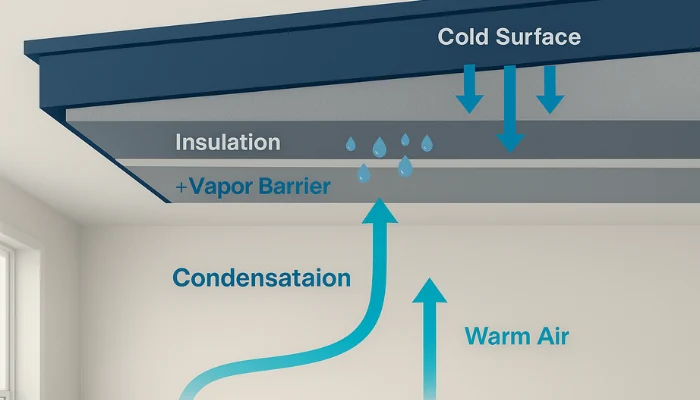
Condensation on flat roofs isn’t random. It happens for clear reasons and most of them trace back to design flaws, poor ventilation or neglected maintenance. Understanding the causes makes it easier to fix and even easier to prevent. Let’s analyze now:
- Poor ventilation and airflow: Flat roofs don’t breathe as easily as pitched roofs. Without proper ventilation, warm indoor air has nowhere to escape. When it meets a cold surface, moisture forms.
- Clues: stagnant air in attic or ceiling voids, rising humidity indoors.
- Fix: add vents or improve airflow with professional inspection.
- Cold flat roof designs: Older homes often use a “cold deck” system: insulation sits below the roof deck, leaving the deck exposed to outside temperatures.
- Problem: the deck becomes a cold surface where warm indoor air condenses.
- Result: soaked insulation, mold, and rotting timber.
- Better option: upgrade to a warm roof design, where insulation sits above the deck.
- Weak or missing vapor control layers: A vapor control layer (VCL) acts like a shield, stopping warm air from reaching the roof deck. Without it, condensation sneaks in easily.
- Issue: cheap or missing barriers in older constructions.
- Consequence: interstitial condensation, damage you can’t see until it’s too late.
- Temperature swings and thermal bridging: Flat roofs take the full hit of weather changes. On a hot day, the surface bakes. At night, it cools quickly.
- Effect: constant expansion and contraction stress the materials.
- Thermal bridging: metal beams or poorly insulated joints transfer cold inside, creating pockets where condensation forms.
Quick reminder from Protect Preserve Roofing: Condensation in flat roofs happens because of weak design, poor airflow, missing barriers, and rapid weather shifts. Know the causes, and you’re halfway to solving the problem.
Flat Roof Condensation Solutions
The good news about flat roof condensation problems is that they can be fixed. Some solutions are simple maintenance steps, while others require bigger upgrades. The right choice depends on how bad the problem already is.
Improving ventilation and air circulation
Ventilation is the easiest place to start.
- Add roof vents or air bricks to allow moist air to escape.
- Clear blocked vents and make sure they’re not painted shut.
- In humid rooms like bathrooms and kitchens, use extractor fans to reduce moisture.
Result: Better airflow keeps condensation from building up inside the roof cavity.
Warm roof vs. cold roof: which works best?
A warm roof is often the long-term fix.

- Cold roof: insulation sits below the deck, leaving the deck exposed to outside temperatures.
- Warm roof: insulation sits above the deck, keeping the structure warm and dry.
Why it matters: Warm roofs reduce condensation risk dramatically, improve energy efficiency, and extend the roof’s lifespan.
Spray foam, rigid insulation and smart vapor barriers
Modern materials give more control over moisture.
- Spray foam (closed-cell): seals gaps and adds insulation but must be installed correctly.
- Rigid insulation boards: prevent cold bridging and strengthen the roof.
- Smart vapor barriers: block moisture when needed but allow structures to dry.
Tip: These upgrades may cost more upfront but save money by preventing structural damage and high energy bills.
Proactive maintenance: inspections and repairs
Prevention is always cheaper than cure.
- Inspect the roof twice a year and after major storms.
- Reseal small cracks and flashing before water gets in.
- Keep gutters and drains clear so water doesn’t pool and add stress.
Pro tip from Protect Preserve Roofing: Flat roof condensation solutions range from small fixes like added ventilation to full warm roof upgrades. The key is acting early. The sooner you fix the problem, the less you’ll spend in the long run.
Costs of Fixing Condensation in Flat Roofs
Condensation repairs can range from quick, affordable fixes to major projects. The cost depends on how much damage has already been done and whether you act early or wait until it spreads. Here is a table with the average values to help you, friend:
| Repair Type | Typical Cost (USD) | Notes |
| Ventilation upgrades (adding vents) | $300 – $900 | Depends on roof size and number of vents |
| Vapor barrier installation | $1,000 – $2,500 | Effective at blocking moisture movement |
| Small insulation patching | $800 – $1,200 | Localized replacement of wet areas |
| Full warm roof upgrade | $6,000 – $12,000+ | Long-term solution, includes new insulation and deck protection |
Emergency tarp installations
When condensation damage turns into active leaks, emergency tarps may be the only option to protect your home while permanent repairs are scheduled.
- Typical cost: $800 to $1,600.
- Factors that increase cost: roof pitch, house height, extent of roof area needing coverage.
- Important note: Never nail or screw tarps directly into the roof. This can cause extra damage and avoid insurance coverage denial. Only in extreme cases (very steep pitch or roofs already beyond repair) should fastening be considered.
Insurance coverage
Insurance companies rarely cover condensation-related damage if it’s linked to poor maintenance.
- Usually excluded: mold, rotting wood, or insulation damage caused by long-term condensation.
- Possible coverage: sudden storm-related leaks that expose condensation issues.
- Key point: quick tarp installation and proper documentation often determine whether a claim gets approved.
Protect Preserve Roofing insight: We’ve seen homeowners catch condensation early and pay under $1,000 for ventilation fixes. We’ve also seen cases where ignoring damp ceilings led to insulation collapse and multi-thousand-dollar repairs. The difference is always how fast you act.
Also read:
Preventing Flat Roof Condensation Problems

Most flat roof condensation problems can be avoided with regular care and a few smart upgrades. The key is consistency, not complexity. Let’s take a look:
- Seasonal inspections and maintenance checks: Flat roofs need attention at least twice a year (in spring and fall) and after any major storm.
- Look for ceiling stains, mold spots or damp odors.
- Check flashing, seams and vents for gaps.
- Inspect insulation for signs of moisture if accessible.
- Gutter cleaning and drainage control: Blocked gutters don’t just cause leaks; they make condensation worse by keeping water on the roof longer.
- Clean gutters and downspouts at least twice a year.
- Remove debris that can trap moisture.
- Ensure water flows away from the foundation, not toward it.
- Choosing the right materials from the start: The best prevention starts with construction.
- Use a warm roof design to keep the deck dry.
- Add a strong vapor control layer during installation.
- Choose insulation that resists moisture and reduces thermal bridging.
- Extra steps for humid rooms: Rooms like bathrooms and kitchens create more indoor moisture.
- Use extractor fans and make sure they vent outside, not into the roof space.
- Add dehumidifiers if indoor humidity stays high.
Pro tip from Protect Preserve Roofing: Preventing flat roof condensation is about staying proactive. Regular inspections, clean gutters, and the right construction choices keep your home safe and dry and your repair bills low.
Mistakes That Make Condensation Worse
Condensation problems in flat roofs often start small, but the wrong choices can make them spiral out of control. Many homeowners think they’re fixing the issue. However, in reality, they’re making it worse. Let’s look at the main mistakes made:
- Covering damp spots without fixing the cause: Painting over stains or patching damp plaster doesn’t solve condensation.
- Why it fails: moisture keeps building inside the roof.
- Consequence: hidden rot spreads while the ceiling looks “fixed.”
- Better move: track down the source, poor ventilation, weak vapor barriers or insulation gaps.
- DIY fixes that fail over time: Flat roofs are tricky. Quick DIY patches may seem cheap but rarely last.
- Example: applying the wrong sealant or blocking airflow with makeshift covers.
- Consequence: condensation stays trapped and damages insulation faster.
- Better move: call professionals for proper ventilation and sealing.
- Ignoring small signs until it’s too late: That tiny stain in the corner of the ceiling? It’s usually the start of something bigger.
- Problem: condensation is silent at first, so it’s easy to dismiss.
- Consequence: by the time visible mold or sagging ceilings appear, insulation and wood are often ruined.
- Better move: investigate any damp sign right away.
- Neglecting gutters and drainage: Clogged gutters don’t just cause pooling, they raise humidity inside the roof space.
- Issue: trapped water keeps surfaces cold and damp.
- Consequence: condensation increases and spreads.
- Better move: keep gutters and drains clear year-round.
Protect Preserve Roofing insight: We’ve seen homeowners spend thousands more because of these mistakes. One case started with a single ceiling stain. Instead of calling us early, the homeowner painted over it. Two years later, he faced a $10,000 repair for soaked insulation and rotted beams. A simple inspection would have saved nearly all of that cost.
Conclusion: Stop Flat Roof Condensation Before It Spreads
Flat roof condensation problems may start quietly, but the damage builds fast. What begins as a faint ceiling stain or musty smell can grow into soaked insulation, rotted timber and repair bills in the thousands.
The smartest move is simple: act early. With the right ventilation, insulation upgrades, and regular inspections, condensation can be stopped before it costs you peace of mind or your wallet.
At Protect Preserve Roofing, we’ve helped countless homeowners catch condensation issues before they became disasters. From emergency tarp installation to full prevention upgrades, we focus on keeping your home safe, dry and protected year-round.
You’ve already taken the first step by learning the signs and causes. Now it’s time to take action. Call us today for a flat roof condensation assessment. You can also schedule a free visit to your roof or get a quick and instant roof estimate.
Don’t wait for hidden moisture to eat away at your home. Protect your investment now and trust a team that treats your roof like their own.
FAQs About Flat Roof Condensation Problems
What causes condensation in flat roofs?
Condensation happens when warm, moist air meets a cold roof surface. Poor ventilation, weak vapor barriers, and cold deck designs make it worse.
How do I know if I have condensation or a leak?
Leaks usually appear after rain, while condensation shows up even in dry weather. If stains or damp odors linger year-round, it’s likely condensation.
Leaks usually appear after rain, while condensation shows up even in dry weather. If stains or damp odors linger year-round, it’s likely condensation.
It’s hidden moisture that forms between insulation layers and the roof deck. You often can’t see it until insulation fails or wood starts to rot.
What’s the best way to prevent condensation in flat roofs?
Seasonal inspections, clean gutters, and a warm roof design with a strong vapor control layer are the most effective prevention methods.


Leave a Reply